THE EARTHQUAKE PHENOMENON THAT TOPPLES BUILDINGS
How can a perfectly designed building survive an earthquake... yet still tilt, settle, or sink as the ground beneath it loses strength?
"The concrete survived. The steel survived. The ground didn't."
The Strange Aftermath
Imagine waking up after one of the strongest earthquakes your city has ever experienced. The shaking has stopped. You rush outside expecting to see collapsed buildings and broken bridges. Instead, you see something far stranger.
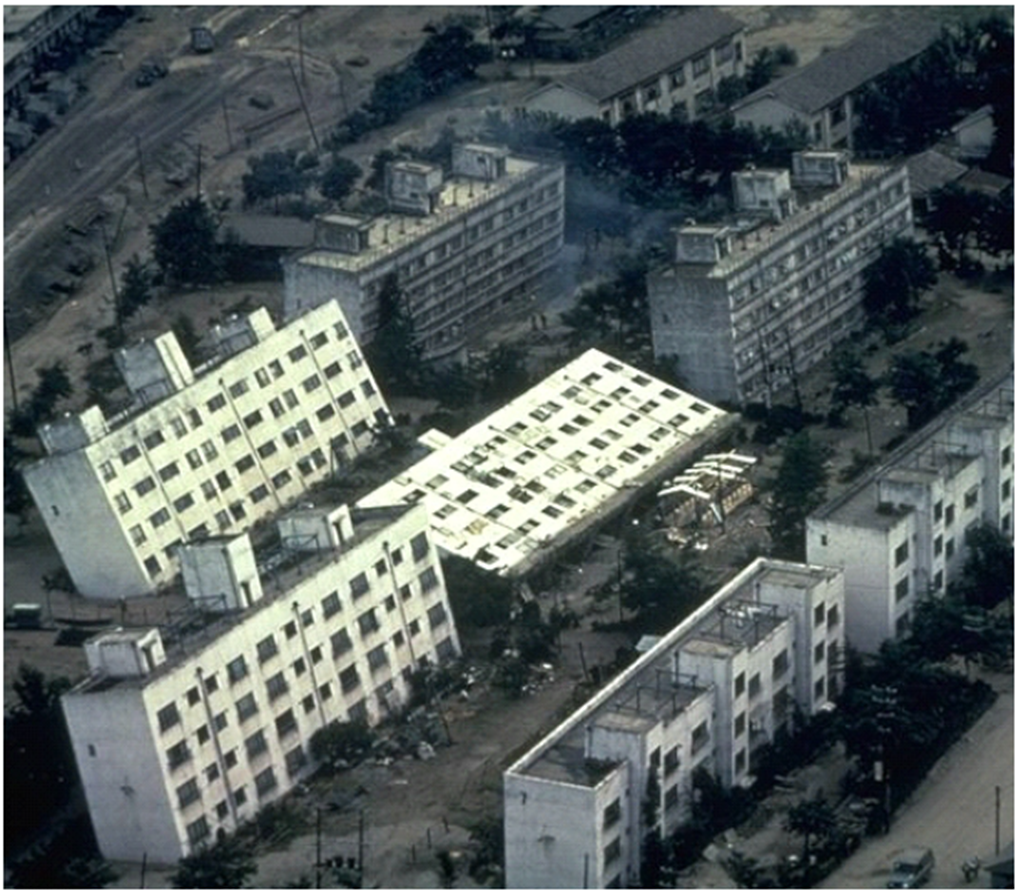
A seven-storey apartment building is still standing. No collapsed columns. No broken beams. No major cracks. Yet the entire building is leaning like the Tower of Pisa. Across the road, cars have disappeared halfway into the ground. Manholes have risen above the pavement. Water mixed with sand is erupting from the streets, while roads buckle and deform like frozen ocean waves.
It feels unreal.
How can soil that appeared solid only moments earlier suddenly lose its strength and behave like a liquid?
Welcome to one of earthquake engineering's most destructive ground-failure phenomena: Soil Liquefaction.
Key Message:
Sometimes earthquakes don't destroy buildings. They destroy the ground beneath them.
The Earthquake That Shook Engineers
Niigata, Japan | 16 June 1964 | Magnitude 7.5
Fig. 1: Leaning reinforced concrete apartment buildings following the 1964 Niigata earthquake, illustrating the effects of soil liquefaction.
The earthquake itself wasn't what changed engineering forever. It was what happened to the ground afterwards.
Entire reinforced concrete apartment buildings remained structurally intact, yet they tilted dramatically because of earthquake-induced soil liquefaction. People were forced to use windows and other openings when doors became difficult or impossible to operate. The buildings hadn't collapsed. They had lost the support of the ground beneath them.
That single event transformed modern geotechnical earthquake engineering, demonstrating how soil liquefaction can cause severe ground deformation and building failure even when the structural system remains largely intact.
The Science Explained Like Never Before
Imagine holding a jar filled with wet sand.
Nothing unusual.
Now shake it. Again. Again. Again.
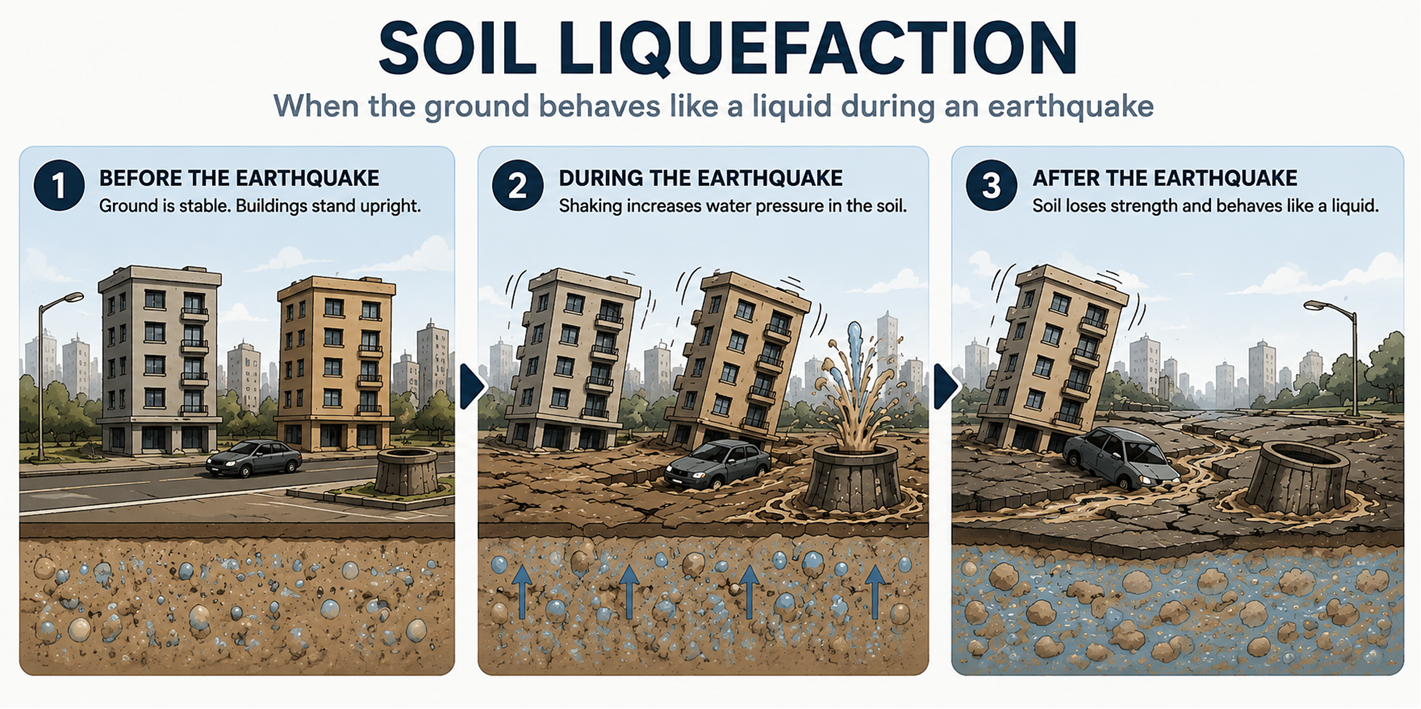
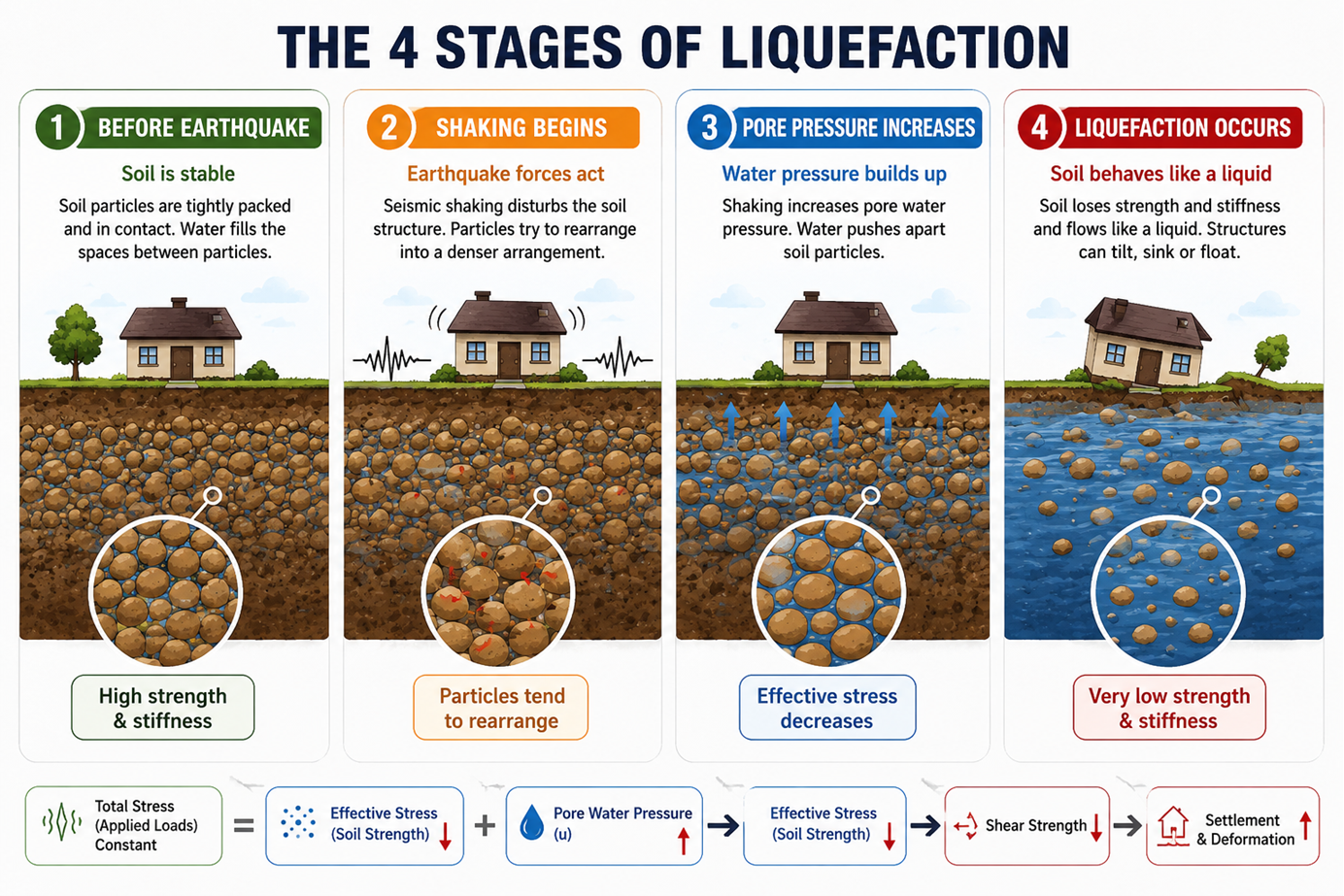
The water trapped between the grains has nowhere to escape. Pressure builds. The grains lose contact, and the soil loses much of its strength. For a few seconds, the jar no longer contains solid ground. It behaves more like a liquid.
This is soil liquefaction.
Five Ways Liquefaction Destroys Cities
The effects of soil liquefaction extend far beyond building foundations. Ground settlement, lateral spreading, and loss of bearing capacity can disrupt entire urban systems.
Failure #1: The Leaning Building
- The Story: Niigata's apartment buildings stood intact but tilted at alarming angles. Residents escaped through windows because doors jammed.
- The Engineering: The soil beneath the foundations lost its bearing capacity due to earthquake-induced soil liquefaction. The buildings didn't fail, but the ground did.
- The Lesson: A building is only as strong as the soil it sits on.
- The Fix: Use deep foundations that reach stable soil layers below liquefiable zones.
Failure #2: Roads Become Ocean Waves
Fig 2: Soil liquefaction occurs when earthquake shaking causes water-saturated soil to lose strength and behave like a liquid.
- The Photo: Streets transformed into undulating surfaces resembling frozen ocean waves.
- The Explanation: Liquefied soil can undergo lateral movement and ground deformation, causing pavements to buckle and crack.
- The Lesson: Transportation networks are vulnerable even when buildings survive.
Failure #3: Sand Volcanoes (Sand Boils)
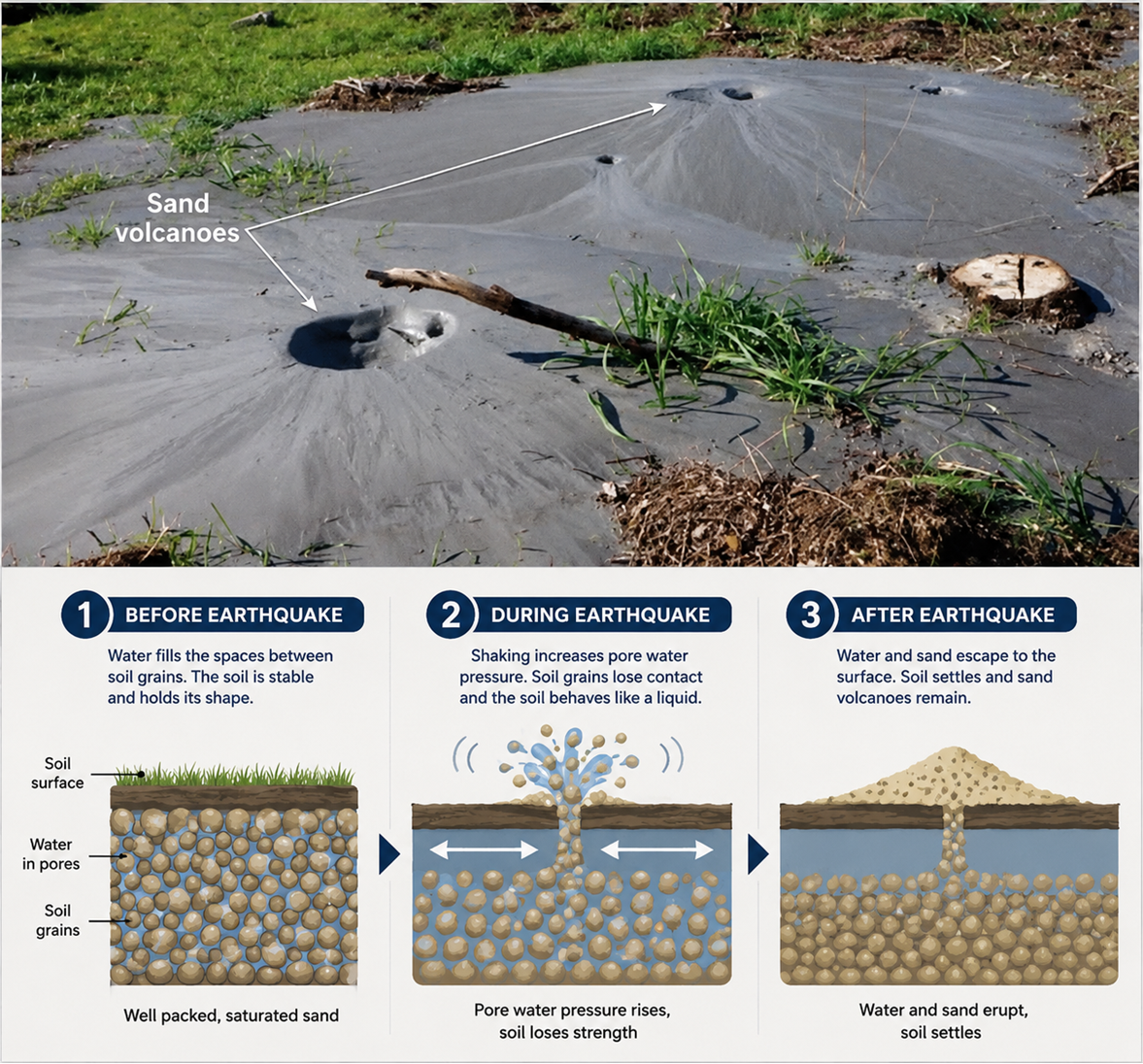
Fig 3: Soil liquefaction during the Christchurch 2011 earthquake, showing rising pore-water pressure, loss of soil strength, and the formation of sand volcanoes.
- The Image: Water and sand erupting from the ground like miniature volcanoes.
- The Explanation: As pore water pressure builds, water and sand find escape routes to the surface.
- The Interesting Fact: Sand boils can continue erupting even after the main shaking has stopped.
- The Lesson: Sand boils are visible signs of liquefaction and indicate that significant changes have occurred beneath the ground surface.
Failure #4: Floating Manholes
Most people never expect concrete to float. Yet it does.
During liquefaction, heavy underground structures become buoyant as soil turns to liquid. Manholes, tanks, and pipes may rise toward the surface while surrounding soil settles around them.
- The Lesson: Even underground infrastructure is vulnerable when the ground liquefies.
Failure #5: Lateral Spreading
Liquefied soil can push riverbanks sideways, shifting bridge foundations, bending piles, and damaging nearby roads and utilities.
Lateral spreading occurs when liquefied soil flows toward free faces like riverbanks or slopes. The horizontal movement can be several meters, destroying foundations, bridge supports, roads, and utilities.
- The Lesson: Liquefaction doesn't just cause vertical settlement; it causes devastating horizontal displacement.
Fig 4: Four stages of soil liquefaction, from earthquake shaking to loss of soil strength and ground deformation.
Could This Happen In India?
Soil liquefaction is not just a historical phenomenon. Several Indian regions have geological and groundwater conditions that can increase liquefaction susceptibility during earthquakes.
| Region |
Risk Factor |
| Bhuj |
2001 earthquake demonstrated liquefaction potential |
| Kandla Port |
Loose, saturated sandy deposits and documented liquefaction during the 2001 Bhuj earthquake. |
| Gujarat Coast |
Extensive alluvial deposits with a high water table |
| Brahmaputra Basin |
Loose saturated sands along riverbanks |
| Kolkata |
Soft alluvial soils with high groundwater can contribute to liquefaction susceptibility. |
| Chennai |
Coastal reclamation areas |
| Kochi |
Reclaimed land and coastal sediments |
Key Question: Are we building tomorrow's cities on yesterday's assumptions?
Can Engineers Stop Liquefaction?
Yes. With proper site investigation, appropriate foundation design, and proven ground improvement techniques, engineers can significantly reduce the risk and impact of soil liquefaction.
| Problem |
Engineering Solution |
| Loose Sand |
Vibro Compaction: Densifies granular soils |
| Weak Soil |
Stone Columns: Improve load-bearing capacity |
| Excess Water Pressure |
Vertical Drains: Accelerate drainage |
| Deep Loose Deposits |
Dynamic Compaction: Heavy tamping densifies deep soil |
| Critical Buildings |
Deep Foundations: Transfer loads to stable layers |
Three Lessons Every Engineer Should Remember Forever
- Buildings don't stand on foundations. Foundations stand on soil.
- The strongest concrete cannot compensate for weak ground.
- Earthquakes test the entire ground structure system, not just the building.
Final Thought
When the ground fails, even the strongest structure becomes vulnerable. Earthquake resilience begins not with the building above ground, but with understanding and preparing the ground beneath it.
Let's Discuss
If you could improve only one aspect of earthquake-resistant construction, which would you prioritise?
- Better buildings?
- Better soil investigations?
- Better construction quality?
- Better building codes?
Why?
Every great structure begins with a great foundation.
Every great foundation begins with understanding the ground beneath it.
Respect the soil. Design for resilience. Build for generations.

Comment ( 1 )
Leave a Comment